
Home / Systems / Network Infrastructure
Everything runs on this
Your cameras are only
as good as your network.
Every camera stream, every badge swipe, every phone call rides the same infrastructure. We build it to handle all of it—today and five years from now.
We install and support




What depends on your network
If the network goes down,
everything goes down.
Video surveillance
4K cameras stream 8+ Mbps each. Twenty cameras needs real bandwidth—not a consumer router.
Access control
Every badge swipe hits the server. Latency means people waiting at doors.
Voice & intercom
VoIP calls and video intercoms need consistent, low-latency connections.
Wi-Fi
Staff, guests and IoT devices all competing for airtime. Designed coverage, not dead zones.
The physical layer
Cabling done
right, once.
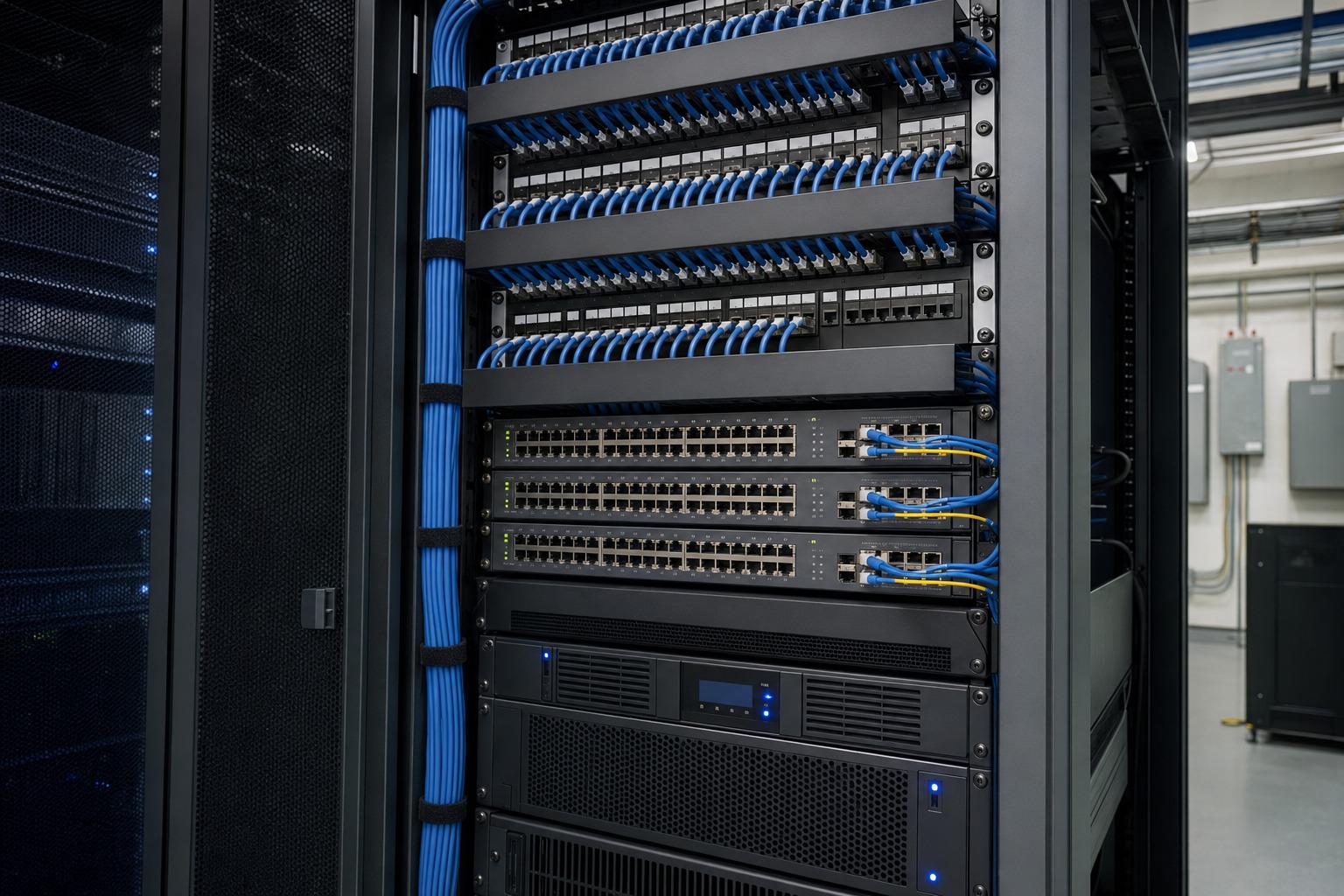
We pull Cat6A and fiber, terminate cleanly, label everything and test every run. No mystery cables. No "I think that one goes somewhere." Documentation you can actually hand to the next IT person.
- Cat6A copper for PoE++ and 10GbE
- Single and multimode fiber for backbone runs
- Labeled, tested and documented
- Pathways sized for future expansion
Power over Ethernet
One cable.
Power + data.
PoE eliminates separate power supplies for cameras, access readers and phones. Fewer failure points, cleaner installs, centralized battery backup.
Common questions
Network Infrastructure FAQs
Can you work with our existing IT team?
Absolutely. We coordinate with in-house IT or MSPs on VLANs, firewall rules and IP schemes.
Do we need new cabling for cameras?
Often yes—especially for PoE cameras. We assess existing runs and tell you honestly what can be reused.
What about Wi-Fi coverage?
We design for density and roaming, not just signal bars. Heat mapping available for larger sites.
How do you document the install?
Every cable labeled at both ends, as-built diagrams and a port map you can actually use.